The following review contains spoilers. They are hidden under tags, so beware!
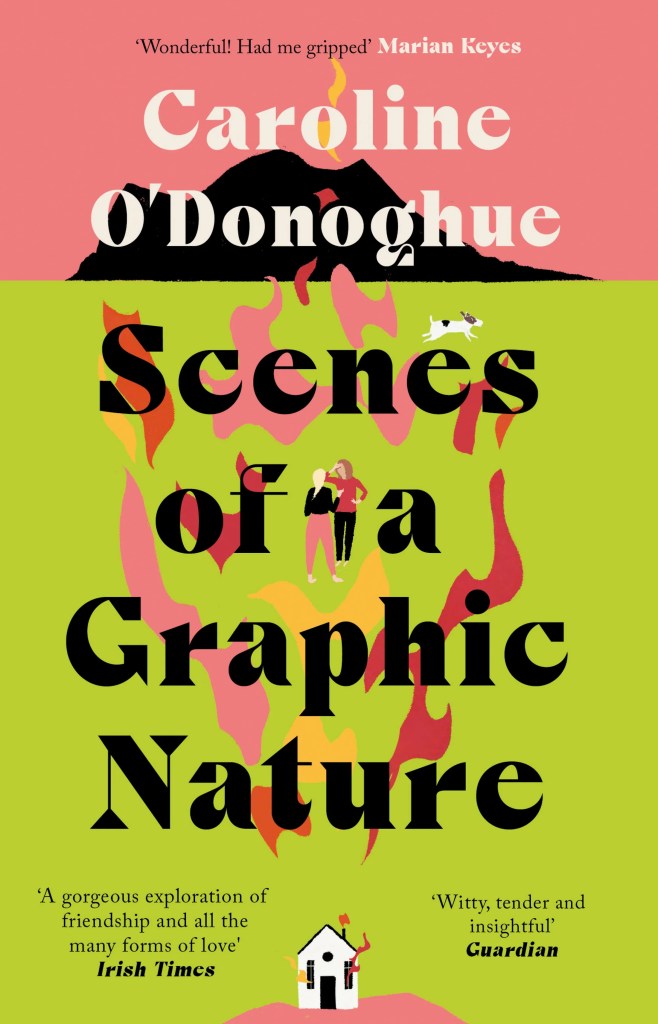
Scenes of a Graphic Nature by Caroline O’Donoghue
Publisher: Virago
Published: June, 2020
Pages: 350
Genres: Contemporary fiction, dark comedy, lgbtqa+, mystery
After a tough few years floundering around the British film industry and experimenting with amateur pornography, Charlie and her best friend Laura take a trip to her familial home on an island off the west coast of Ireland. Her father’s health is rapidly declining and this could be the last chance to connect with her roots. But events on the island cause Charlie to doubt her father’s childhood stories – and then there’s her complicated relationship with Laura. Pursuing the truth will shatter everything she thought knew – but is that what it takes to grow up?
I kept my promise and read Scenes of a Graphic Nature, my second book by Caroline O’Donoghue, and I’m sad to say this one was also not what I was expecting.
But starting with the parts I liked. For one, O’Donoghue’s prose is simple but captivating, and while her characters sometimes annoy me with their choices, I can’t say they aren’t compelling. In fact, this novel reminded me a lot of this show called Bodkin. The protagonist, like Charlie, also ends up in a small town in Ireland, investigating a mystery, though for different reasons, and both protagonists are also lesbian fuck-ups.
Another plus for me was that the entire book was set in the present, with the exception of a short fast-forward moment at the very end (Sigh… We’ll get to that…). After the endless confusion between timelines of TRI, I was happy to stay in a straightforward one.
Now, moving on to the parts I didn’t like… For one, the beginning of the book, set mostly in England, and the part that follows Charlie and her friend Laura into Clipim felt like two different stories. Partly because of the mood difference, things get dark fast when they get to the island, but the transition felt a bit clunky. But I also think this is due to pacing. Charlie is only really faced with the mystery and starts investigating it at about forty-something percent of the book, which felt way too late to me, especially since the story only takes place over a handful of days.
Another point that bugged me was the fact that issues like a) Charlie’s conflict with her mother, b) her lack of money, which led her to c) amateur pornography, were mentioned a handful of times, but did not carry the weight I imagined they would for the character. It felt more like these problems were used as plot advancements than that they actually were parts of who Charlie was as a person. Another plot point that felt completely lost on me was the existence of Benjamin Barry. He was a looming figure who seemed very threatening up until the point where he actually threatened Charlie and then… nothing. That thread fizzled out and I don’t think he is even mentioned after a certain point, even though his actions were impactful enough that they begged for some sort of resolution.
This book also did hold some confusion for me because O’Donoghue named two characters who live on the island and also frequent the same spaces at the same time, Mary and Maria. Charlie’s first interaction with Mary, the island’s alcoholic, was when she helped the old lady with her pants in the bathroom. This scene was promptly followed by Charlie getting closer with the rest of the islanders, who include the young and beautiful Maria, on whom Charlie develops a crush. I immediately thought Charlie now wanted to help the old lady out of her pants… You can see my confusion, can’t you?
This book dealt with some serious heavy material, such murder, domestic violence, alcoholism… But the author merely skimmed the surface of these issues.
Click here to see a spoiler
The domestic violence plot point, for example, appeared twice, both in relation to old Mary and to Maria, the love interest (again, these two!). Old Mary was assaulted by her husband after she drunkenly revealed too much information about the past to Charlie, while Maria confesses to her that she was still married to a man she ran away from because of the abuse. The thing is, Maria used her experience with abuse to justify the actions of Dónal, a friend of hers who had gotten too heated up about Charlie’s snooping around and had tried to drown her. Yes, she really did that. Her exact words were “(…) maybe if you got the absolute shit beaten out of you every day you would understand that getting your face wet isn’t the end of the world.” And there was never an apology between any of the characters. Charlie felt bad for the abuse Maria went through, Maria thought Charlie was overreacting and Dónal went unpunished for what he had tried to do.
Another thing that bothered me was that Charlie’s mother, with whom she had a very tense and strained relationship, had suddenly softened up on the phone, especially after her daughter had missed the plane home and would not be at her father’s side during his surgery. Nothing really happened in between the one phone call where her mother was livid and the one where she was reminiscing about the past and laughing. For such a complicated character, her mother’s sudden change of attitude seemed out of place to me. It would have been nice to see a more substantial change happening between them.
And finally, the ending. After a few days of running around the island and coming up with several theories as to why the children and their teacher had died at the school, the mystery is “resolved” by Joe, the ferry guy, who spills his own theory of what happened to Charlie after she has burned all of her bridges in Clipim. Yes, his theory, because there’s nothing to prove what he says, exactly, though there’s nothing to disprove it either. So, at about ninety-percent of the book, we get two entire chapters of Joe just talking at Charlie.
This was very disappointing because the mystery itself was compelling, and its “resolution” too, if only it had been executed in an interesting, active way. The way this was relayed felt very lazy to me, especially after over three hundred pages of back and forth with Charlie.
On top of that, the very next chapter after the reveal is the very last one of the book. Titled “Later”, it opens with a wake, which, since the very reason this Irish adventure of Chalie’s started was her father’s sickness, made me think it was his. But no, it turned out it was Enda’s, one of the islanders. In other circumstances, this could have been an interesting play, but I was already dejected by the overly expository reveal.
As with TRI, Scenes of a Graphic Nature also had me lost with threads that seemed to go nowhere and good prose that was over telling. This book had a very interesting premise, which I, a lover of sleuths (especially fucked up ones), was sure I would love. The problem was, every time the story seemed to touch on a deeper theme, the narrative would skim over it and turn a corner.
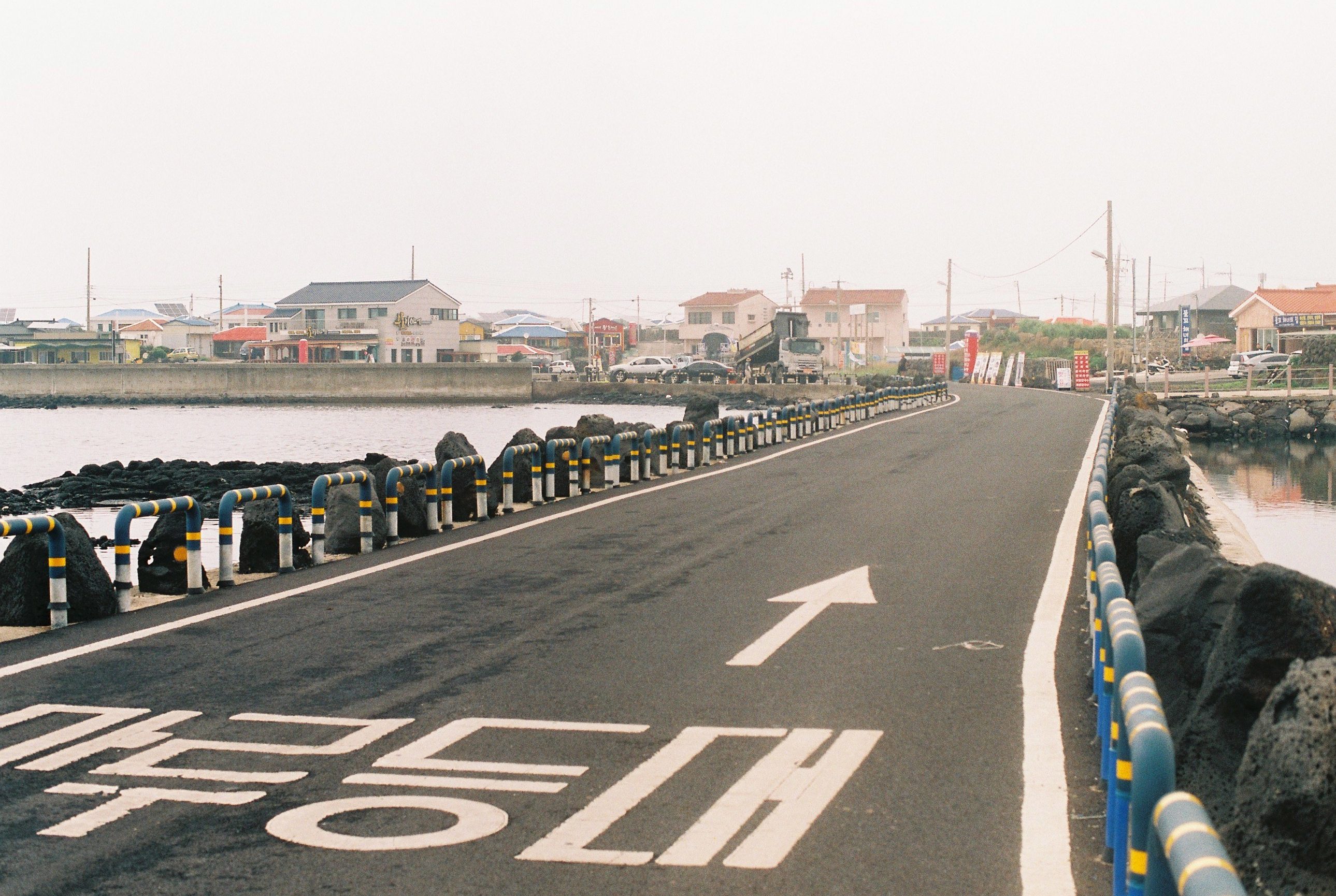
Though I do have a few more pictures of Ireland, I chose one taken in South Korea instead. It was from my first trip to Jeju Island, more specifically, Udo or U Island, a tiny island just off the coast of Jeju.
It was a rainy day and no one was out except for me and the 해녀 (haenyeo or sea women, female divers who make a living by harvesting sea life in the island). The moody atmosphere reminded me of Ireland and also of the not-so-welcome vibe of the islanders in SGN.
If anyone is thinking about visiting Jeju, though, do not fret. The island is safe and welcoming, even when it rains.

 Proseography
Leave a comment